Since 1967
One name. Two communities. A shared love of football.
Doncaster Rovers Soccer Club exists because Ray Shew wanted to bring his love of football, and a connection to his hometown of Doncaster in England, to his new community in Australia.
From uncertain beginnings, his vision grew into a club that has given thousands of players and families the opportunity to be part of the game.
On the pitch
A club that has climbed
Doncaster Rovers Soccer Club was formed in 1967 and named after the English club Doncaster Rovers. Its most successful period was in the 1990s, during which it spent the majority of the decade in Division 1 of the State League.
In 1994 the club were crowned champions of Division 1 and promoted to the Victorian Premier League. After one season in Victoria’s top flight they were relegated, finishing second last.
Our story
From one Yorkshireman's vision
Nearly sixty years of Doncaster Rovers, from a meeting almost nobody came to.
-
1966
Ray Shew arrives in Melbourne
Ray Shew, who grew up in Doncaster, England, migrated to Australia and settled in the Melbourne suburb of Doncaster. Having played football in the UK, Ray was determined to establish a local club in his new community.
-
8 November 1966
An uncertain beginning
Ray booked the Athenaeum Hall for 8.00pm to discuss forming a soccer club in Doncaster. When no one had arrived by eight, he began to fear the idea had failed. Within the next 20 minutes, however, a small group had gathered and voted to establish the club.
-
Late 1966
The first committee is formed
Stan Shepherd became the club's first President, with John Dunkley appointed Vice President, Ray Shew as Secretary and Colin Mainwaring as Treasurer. Together they began securing players, facilities and the foundations of the new club.
-
1967
A home and a place to play
The club became the first tenant of a newly completed local pavilion. Establishing the playing facilities required patience and determination, as council staff had little experience preparing soccer pitches. Two grounds were planned to support both senior and junior teams.
-
25 March 1967
Our first competitive match
Doncaster played its first match against Mooroolbark on a school ground in Bayswater. Volunteers arrived to find an unmarked paddock without goalposts and had to prepare the ground before the reserve match could begin.
-
Our first colours
From gold and green to all white
The club originally planned to wear gold shirts with green shorts, but gold shirts were not readily available in Australia. Green shirts and white shorts were chosen instead, although delays meant the team played its first fixture entirely in white.
-
1967
The first season begins
After scoring in the opening minute of its first senior match, Doncaster eventually lost 6–2 to the more experienced Mooroolbark side. The following week, the club recorded its first victory against Rosebud.
-
1967
The junior program flourishes
The club initially planned to enter two junior teams, but interest grew quickly and more teams were soon formed. Coaching and playing space became early challenges, but the club's commitment to giving young people the opportunity to play was firmly established.
-
1967–Today
A community built through football
From those small beginnings, Doncaster Rovers has welcomed thousands of players, children, families, coaches and volunteers. Ray's vision created far more than a soccer club. It created a lasting community.
-
31 May 2023
Remembering our founder
Ray Shew passed away after leaving an extraordinary legacy. His drive, passion and dedication remain at the heart of Doncaster Rovers, deeply rooted in his love of football and his hometown of Doncaster, England.
-
2027
Celebrating 60 years
Doncaster Rovers will celebrate its 60th anniversary as one of Victoria's long-standing community football clubs, proudly carrying the Doncaster name and continuing Ray Shew's vision for future generations.
Recognised
Life members
Thirty people the club has recognised for lasting service, from its founder in 1967 onwards.
- 1967 Ray Shew
- 1969 Stan Shepherd
- 1977 Neville Irwin
- 1978 Russell Gow
- 1978 Graham McIntosh
- 1981 Ron Forsyth
- 1983 Alan Rankin
- 1986 David Casson
- 1986 Doris Casson
- 1986 Des Hall
- 1986 Audrey Humble
- 1987 Gordon Culbard
- 1988 Robert Morrison
- 1989 Eric Hess
- 1992 Bill Podlewski
- 1992 Jim Rapson
- 1994 Alan Pearson
- 1994 Ted Sewards
- 1995 Cathie Culbard
- 2000 Vic Bakic
- 2006 Steve Hargitay
- 2006 George Moutafis
- 2011 Margot Walker
- 2012 Peter Apostolopoulos
- 2014 John Palomares
- 2016 Kieran McManus
- 2016 John Pellarini
- 2016 Chris Pavlidis
- 2016 Nick Palamaras
- 2017 Brian Durrant
The record
Club founder
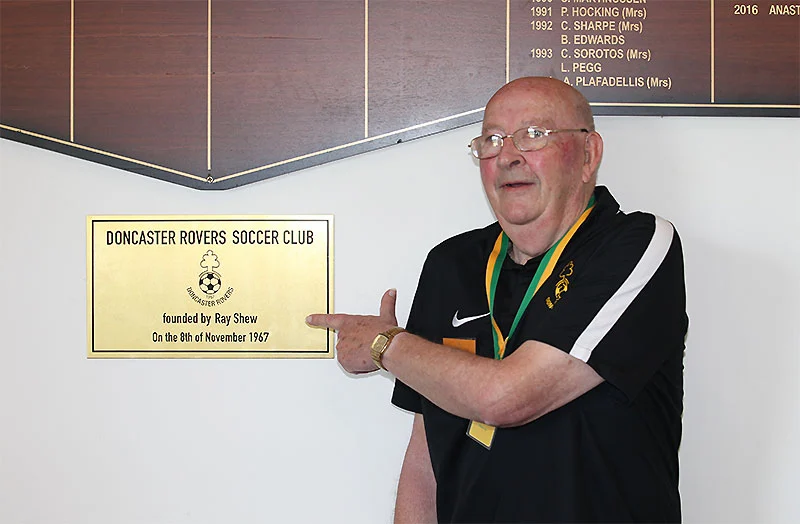
1967 — Ray Shew. Doncaster Rovers exists because Ray Shew called a meeting in the Athenaeum Hall in November 1966 and enough people came.
Honour board
Captains, presidents and the Club Person of the Year, recorded since the club's first season in 1967.
Team captain
| Years | Name |
|---|---|
| 1967 – 1969 | D. Martin |
| 1970 | D. Martin |
| 1971 – 1973 | H. Daly |
| 1974 | R. Head |
| 1975 | H. Daly |
| 1976 | P. Stevens |
| 1977 – 1979 | A. Copeland |
| 1980 | I. Humble |
| 1981 | A. Copeland |
| 1982 – 1984 | I. Humble |
| 1985 | R. Tolme |
| 1986 – 1994 | I. Humble |
| 1995 | D. Hennessey |
| 1996 | J. Caniglia |
| 1997 | G. Szapnik |
| 1998 – 2000 | S. Hackett |
| 2001 | P. Boyes |
| 2002 – 2003 | S. Hackett |
| 2004 – 2008 | R. Ardesi |
| 2009 | M. Santoro |
| 2010 | J. Petridis |
| 2011 | N. Kalifatidis |
| 2012 – 2013 | M. Godfrey |
| 2014 – 2016 | R. Taylor |
| 2017 | N. Kalifatidis |
| 2018 – 2019 | C. Bonello |
| 2020 | M. Wright |
| 2021 | |
| 2022 | S. McRae |
| 2023 – 2025 | M. Papanicolaou |
| 2026 | N. Ansell |
Club president
| Years | Name |
|---|---|
| 1967 – 1968 | S. Shepherd |
| 1969 | M. Russell |
| 1970 – 1972 | S. Shepherd |
| 1973 – 1975 | R. Gow |
| 1976 – 1980 | R. Forsyth |
| 1981 – 1982 | G. McIntosh |
| 1982 – 1986 | C. Gulbard |
| 1987 | P. Stevic |
| 1988 | A. Copeland |
| 1989 – 1990 | R. Shew |
| 1990 | W. Podlewski |
| 1991 – 1992 | T. Main |
| 1993 | M. Coffey |
| 1994 – 1995 | G. Culbard |
| 1996 | R. Gow |
| 1997 – 2001 | E. Sewards |
| 2002 – 2009 | S. Hargitay |
| 2009 – 2012 | P. Apostolopoulos |
| 2013 – 2015 | J. Palomares |
| 2015 – 2016 | A. Moutafis |
| 2017 – 2023 | N. Trimmatis |
| 2024 – 2026 | J. Aspropotamitis |
Club person of the year
| Year | Name |
|---|---|
| 1967 | J. Dunkley |
| 1968 | V. Bakic |
| 1969 | J. Rapson |
| 1970 | H. Daly |
| 1971 | H. Vloedemans |
| 1975 | O. Anselma |
| 1976 | D. Casson (Mrs.) |
| 1977 | A. Clarke, M. McIntosh (Mrs.) |
| 1978 | W. Zull |
| 1979 | P. Guerts |
| 1980 | M. Hocking |
| 1981 | B. Durrant |
| 1982 | A. Humble (Mrs.) |
| 1983 | A. Rowell |
| 1984 | B. Spicer |
| 1985 | E. Hess, L. Hickey |
| 1986 | C. Culbard (Mrs.) |
| 1987 | K. Sharpe |
| 1988 | T. Main |
| 1989 | B. Wood |
| 1990 | S. Martinussen |
| 1991 | P. Hocking (Mrs.) |
| 1992 | C. Sharpe (Mrs.), B. Edwards |
| 1993 | S. Sorotos (Mrs.), L. Pegg |
| 1994 | A. Plafadellis (Mrs.) |
| 1995 | V. Shultz, L. Shultz (Mrs.) |
| 1996 | M. Pearson (Mrs.) |
| 1997 | B. Spittle |
| 1998 | B. Durrant |
| 1999 | J. Pellarini |
| 2000 | A. Hargitay (Mrs.), D. Pellarini (Mrs.) |
| 2001 | G. Lord |
| 2002 | G. Lord |
| 2003 | C. Pavlidis |
| 2004 | A. Wilson |
| 2005 | K. McManus |
| 2006 | M. Walker (Ms.), P. Kafalianos |
| 2007 | L. Quinn (Mrs.), D. McCarthy |
| 2008 | N. Palamaras |
| 2009 | J. Talia, H. McCarthy (Mrs.) |
| 2010 | No nomination |
| 2011 | A. Roodhouse |
| 2012 | L. Bamford |
| 2013 | R. Fleming |
| 2014 | J. Palomares |
| 2015 | L. Sambuco |
| 2016 | Anastassiou Family |
| 2017 | J. Lindrea |
| 2018 | J. Jarvis, M. Ivanusic |
| 2019 | F. Vetere, S. Korkoneas |
| 2021 | C. Stavretis |
| 2024 | A. Mutton |
| 2025 | W. Minster |